Far from being an opinion, it is enough to review what happened in the 90s. Photo: Indymedia Argentina
The plan to disarm workers
On what is this attack based?
Restricting the right to strike — even more than established by the Bases Law. Limiting union activity in the workplace, for example, by requiring employer authorization to hold a meeting, under penalty of sanction. Reducing the number of delegates in the workplace: the minimum number of employees to have a delegate was 10 and now it rises to 50, and the right to have delegates per shift is eliminated. Eliminating union protection (the right not to be dismissed or have working conditions changed for being a candidate or having been elected) for alternate positions or delegates to congresses — imagine how difficult it will be to put together a list if this happens. Limiting union funding to membership dues. With these measures, what is being attempted is to create union-free workplaces, with weak and underfunded unions.
The cherry on the cake of the draft is the attempt to pulverize the collective bargaining model: it eliminates ultraactivity — the mechanism that guarantees a convention remains in effect until a new one is signed; it suppresses the bargaining floor generated by activity-based conventions; it enables downward bargaining; and it prioritizes company-level bargaining.
Photo: Indymedia Argentina
Although the official project has not yet seen the light of day, the message is clear: the challenge is to resist.
Photo: Indymedia Argentina
The Government is advancing with a labor reform that, although it does not yet have a definitive form and we only know drafts, already shows its crudest face: it is a direct attack on the reproduction of the life of the working class.
Once again, what might seem like a deterioration only for the sector of formal employees covered by collective agreements ends up, sooner rather than later, generating a general decline in the living conditions of the entire working class. If there is less registered employment, there are fewer contributions, and therefore, worse retirement benefits, pensions, and other social benefits. But it must also be an opportunity to build, from the ground up, the agenda for reforms and rights that we who live from our work really need. Conflicts such as those in public education, Garrahan hospital, people with disabilities, and retirees are some examples of the disputes for the reproduction of life, which build bridges and show the power of solidarity in the struggle.
"This is a battle that involves the entire working class, from the most consolidated sectors to the most precarious."
Unfortunately, this is not new: there are already company-level agreements that include this type of workday regulation.
Women with formal jobs and union activists who have been fighting to transform these inequalities in care receive a blow to their demands. This, added to the payment of discretionary additional payments (called dynamic additional payments) and the loss of overtime pay, is fatal for the wallets of working families, because we won't know which days, how many hours, or how much we are going to earn at the end of the month.
March to the Congress so that Deputies overturn the vetoes to the Garrahan and Public University laws on September 17, 2025.
Not all people can adapt to these forms of work, particularly women, who usually take on the responsibilities of child-rearing and caring for people who need assistance. The same is true for other leaves that have been demanded and are essential for the care of others and for self-care. The chances of achieving better labor rights are at stake, not only because of the more exploitative modalities that want to be imposed, but because of the direct attack on union organization and collective bargaining. This negatively impacts our conditions for the reproduction of life, both present and future.
Source: Prepared by Luis Campos of the IEF-CTA
Source: Prepared by Luis Campos of the IEF-CTA
Hour Bank: flexibility for the employer, uncertainty for the worker
Much ink and words have been dedicated to the hour bank, a system that allows adjusting the workday to the company's production needs and saving on overtime pay.
This orientation is not casual: all these norms, including the reform draft, were cooked up unilaterally between the Government and the legal firms of the business chambers.
By Jimena Frankel (Indymedia Argentina).
The concrete evidence is that the reforms that the Bases Law already introduced —such as the elimination of fines for unregistered work and the creation of new non-labor figures— imply a decrease in the "labor cost" for companies, but no benefit for workers.
The problem that the draft project introduces is that it allows moving towards even more precarious and perverse modalities, where the employer decides how many hours a day you are going to work —be it 0 or 12—, with the only limitation of a 12-hour rest between shifts.
If the Congress endorses it, even in part, based on current rumors, there will be no job creation or improvements; only a deeper adjustment and a generalized deterioration.
Let's remember that this leave is not paid by the company, but by the State.
The draft project completely ignores the historical conquests and demands of the women's and diversity movement.
Official data do not show a generation of registered employment, but quite the opposite.
This fact further precarious the conditions of the entire working class, because it lowers the general floor of labor conditions: it affects those who have a job, future and current workers, and current and future retirees.
That is to say, it only allows the worker to return to her job 15 days earlier; it does not add anything, but rather distributes part of a legal leave that had already been extended by many collective agreements.
Photo: Indymedia Argentina
The gender impact: the life that is not shared
These new workday modalities generate brutal wear and tear on the bodies and minds of the working class, and especially affect the management of the reproduction of one's own life and that of those under one's care.
March of social movements, the CGT and the CTA "Peace, Bread, Land, Roof and Work" on August 7, 2025.
Faced with this attack, the test will be our capacity to respond.
On the contrary, it reduces the maternity leave by "allowing" the last 15 days to be shared.
Therefore, these modalities exacerbate gender inequalities and reinforce the feminization of the reproduction of life.
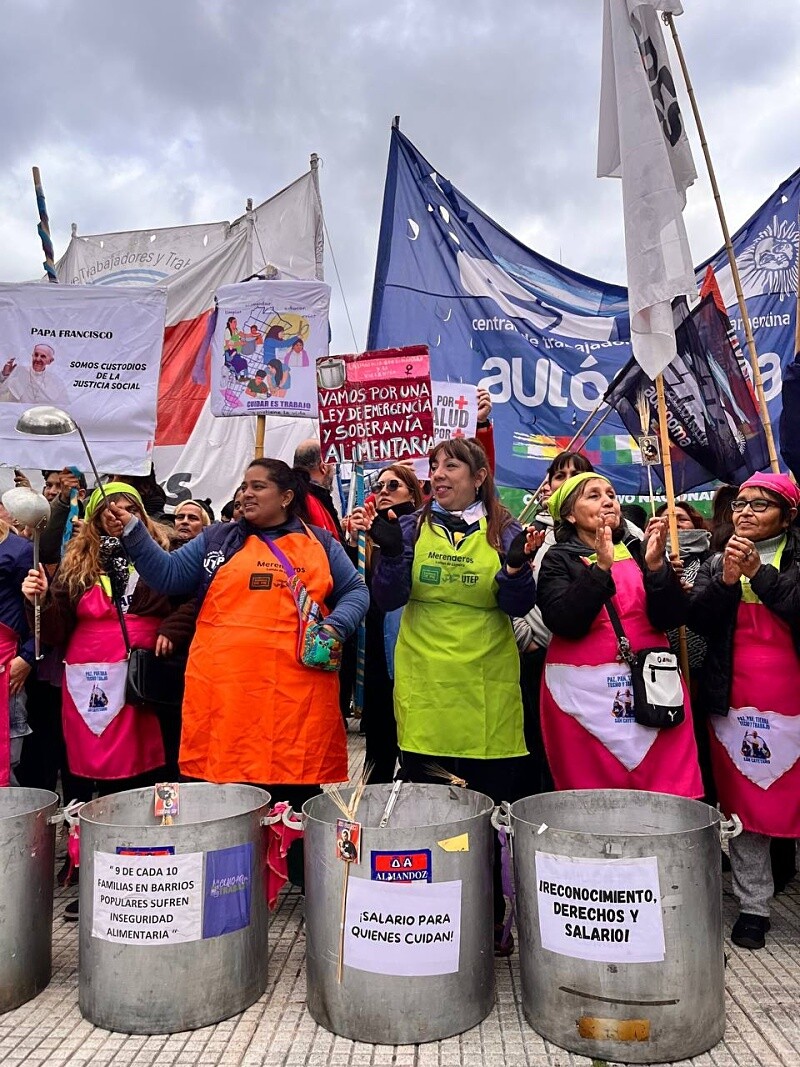
8M 2025 in Buenos Aires.
It is a plan that seeks to have us more exploited, disciplined, disarmed, with less time to live, meet, discuss, and dream of the world we want as a class.
If a few years ago extensions of leaves or shared leaves for child-rearing were demanded, the draft project does not propose any of this.
In addition, it is women who, in general, access positions with a lower workload and/or lower salaries.
Photo: Indymedia Géneros.
But that's not all.
The setbacks of the Bases Law and the content of Decree-Law 70/23 (blocked by the unions) show the pro-employer bias of the management.